A comprehensive bibliography of research articles on trauma injuries in rural areas on MedLine
Farm Hazards and Injuries
Agriculture is one of the most hazardous industries in this country, with more than 700 occupational fatalities and 120,000 work-related disabling injuries occurring annually. Injuries can result from farm equipment accidents as well as exposure to pesticides, fertilizers, methane and other chemicals.
Rod Landrum (pictured with wife, Karen) credits the Kansas trauma care system with saving his life after a farm injury.
In March 2006, Rod Landrum fell 30 feet off the barn on his farm near Parsons, Kan. Today Landrum is a walking advertisement for the Kansas trauma system, implemented statewide in 2001, which Landrum credits for saving his life.
“I had more bones broken than not on my right side,” Landrum said. “For four weeks I never knew what was going on because I was unconscious. I would not be alive today if it weren’t for the trauma team. The system worked perfectly.”
“They did all the right things,” he added, “starting with our local EMS department that had the vision to get trauma training and got to my farm within three or four minutes, then on to our local hospital a couple miles down the road that stabilized me, and on to the helicopter system that airlifted me to the trauma center and the skilled professionals who cared for me the three months I was hospitalized.” His injuries included a broken neck, hip, back and knee, broken arms, wrists and facial bones, and some brain trauma.
Landrum, who is back at work full-time, spent months learning to speak, write and walk again. He is one of the fortunate ones. People living in rural areas are less likely to survive major traumas, which contribute to the sudden, unexpected deaths of an estimated 160,000 Americans each year, according to a national assessment survey by the Health Resources and Services Administration (HRSA). Trauma is the leading cause of death for Americans 35 and younger, and permanently disables 80,000 Americans every year. Often referred to as the neglected disease of the 21st century, trauma encompasses a variety of conditions attributed to injuries, accidents and violence.
Nearly 60 percent of all trauma deaths occur in rural areas where only 20 percent of the nation’s population lives. Optimal care can be compromised by a variety of factors, including long distances to medical facilities, weather conditions, poorly maintained roads and other geographic factors. Additionally, many small rural facilities lack resources and have little experience caring for trauma patients due to low volumes and lack of trauma training.
Organized trauma care systems are critical to reducing mortality and morbidity rates in rural America, according to Dr. Nels Sanddal, president of the Critical Illness and Trauma Foundation. “What we can say with confidence from pre- and post-trauma system preventable mortality studies is that a trauma system results in fewer unnecessary deaths. It is the organization, integration and appropriate utilization of existing resources that makes a difference, even in rural and frontier areas where those resources may be very limited."
In Washington, where a statewide system was fully implemented and funded in 1995, trauma was the fifth leading cause of death for all ages and the cause of 75 percent of deaths for ages 15-24. From 1995 to 2006, the number of patients surviving major trauma incidents increased from 75 to 86.5 percent.
“That means an additional 2,000 lives were potentially saved if the 1995 case fatality rate had remained the same,” said Washington State Trauma Plan Section Manager Kathy Schmitt.
Access to Trauma Care Varies by State
But access to a coordinated trauma care system varies widely across the nation. Only 24 percent of rural residents have one-hour access to Level I or II trauma centers, compared to 86.2 percent of suburban residents and 95.3 percent of urban residents, said Charles C. Branas, a University of Pennsylvania professor who has conducted extensive trauma research. Trauma centers are listed in classes, with Level I and II centers providing the most comprehensive care for critically injured patients and Level III-V centers providing emergency care. The American College of Surgeons verifies Level I-III trauma center status. Level IV and V status is designated by the states.
Branas said about 46.7 million people do not have access to a trauma center within what is known as the Golden Hour, the first 60 minutes after an injury when trauma care is most effective in saving lives. Landrum arrived at a Level I trauma center 54 minutes after his fall. Trauma system advocates say that trauma centers must be supported by coordinated trauma care systems, particularly in rural areas where distance already works against speed.
Trauma systems are intended “to ensure each patient is properly triaged and matched to the hospital with the most appropriate resources as quickly as possible,” explained Chris Tilden, Kansas Office of Local and Rural Health director. “Kansas had systems in place before the creation of the trauma system but no formal process for regional or statewide coordination. There was communication on the local level, but no systematic process.”
Kentucky is one of the states without a trauma system for routing critically injured people to the closest appropriate trauma center.
“The death rate in rural parts of Kentucky is more than 50 percent higher than urban areas,” said Dr. Jeffrey Coughenour, a trauma surgeon at the University of Kentucky Chandler Hospital in Lexington. Frustrated by the lack of a trauma system in Kentucky, Coughenour, the Kentucky State Office of Rural Health and other medical providers are developing a regional trauma care plan.
Kentucky has three Level I centers, one Level III center and many capable EMS providers, Coughenour noted. But the trauma centers are all located in the state’s center, care is fragmented and rural people in border areas are a considerable distance away. In the last six months, Coughenour said they have established a regional trauma advisory council, developed a systematic triage protocol for participating providers and have been offering Rural Trauma Team Development courses in small hospitals. With the eight-county area surrounding Lexington involved now, they plan to extend efforts to other area counties.
Coughenour said health care providers and public surveys indicate support for a statewide trauma care system, but numerous legislative acts have been introduced over the years and never passed.
“We take care of these people every day and we know how it needs to work,” he said. “We can’t wait any longer. It’s irresponsible of us as leaders in trauma care not to act. The state has not made any progress in coming up with a coordinated trauma plan in the last 10 years.
Rural Hospitals Playing a Stronger Role in Trauma Care
In states where trauma care systems are in place, rural care is being enhanced through inclusion of Critical Access Hospitals (CAHs) as lower-level centers. The Office of Rural Health Policy at HRSA is requiring all State Rural Hospital Flexibility Programs, as of this year, to work with CAHs in their states to get them certified as Level III and IV trauma centers. (For more information, see the Rural Health Resource Center's Emergency Medical Services (EMS): Tools for State Flex Programs.
Dr. Jim Harris is the trauma medical director at Riverwood HealthCare Center in Aitkin, a CAH that is Minnesota’s first Level III center. Harris said Level I and II centers are approximately 2½ hours by ground and 40 minutes by air from Aitkin.
“I think what’s most helpful about this is that EMS providers know now what we can take care of in our hospital and what they’d be better off sending directly to Level I or II,” Harris said. “Before, doctors made that decision on the fly as patients came in the door. Treatment is rendered more quickly and more consistently. Training for our smaller hospital is a big part of it too. Having everyone know what constitutes a trauma alert and what’s expected in patient management certainly benefits patients and outcomes.”
Rural hospitals provide resuscitation, stabilization and transfer to higher-level care centers. Washington, which has 23 CAHs in its system, has designated Levels I-V for trauma centers.
“From the very beginning, rural hospitals were involved in the planning system,” Schmitt said. “We have a lot of wilderness areas. Those patients would die, I’m sure, if these rural hospitals didn’t fill the role they do in our trauma plan.”
Working Toward Coordinated Care Nationwide
Washington and Kansas are among states that have reciprocal agreements with bordering states. Patients are transported to the closest facility, regardless of state lines. Branas and his colleagues have recommended that all state plans should share trauma care resources across borders to improve access.
While the number of trauma centers has increased, no national plan exists to ensure access for everyone. Geographic distribution of trauma centers and service coordination varies widely from state to state, Branas said.
Trauma systems face numerous challenges, primarily related to high expenses and limited state and federal funding. The HRSA national assessment survey concluded, “... economic support for trauma systems appears to be a major concern among all states.”
Rod Landrum, who celebrates life every day, wants to raise public awareness of the need to support trauma systems in each state and develop coordinated trauma care nationwide.
“I believe I need to give back to the system that saved my life,” he said. “My goal is to speak out wherever the opportunity presents itself. If I just help save one life through my efforts, then I will know I am serving a greater cause.”
Landrum would be happy to speak to anyone about his experience. He can be contacted at rod[at]par1.net.
The following states and statewide programs were mentioned in this issue:
Kansas Kansas Trauma Program
Year Implemented: 2001
Goal: The Kansas Trauma Program is a partnership between public and private organizations to address the treatment and survival of critical injuries throughout the state.
Washington Office of Emergency Medical Services and Trauma System
Year Implemented: Fully implemented in 1995
Goal: To establish and promote a system of emergency medical and trauma care services. Such a system provides timely and appropriate delivery of emergency medical treatment for people with acute illness and traumatic injury, and recognizes the changing methods and environment for providing optimal emergency care throughout the state of Washington.
In addition, the American College of Surgeons (ACS) offers a list of individual Verified Trauma Centers, by state. The list includes only those trauma centers that have successfully completed a verification visit.
People who live in rural areas are at a much higher risk of injury or death from motor vehicle crashes. About 60 percent of traffic fatalities occur in rural areas, the majority of them on two-lane roads, according to the Center for Excellence in Rural Safety (CERS). One-fifth of the American population lives in rural areas, yet three-fifths of the 42,642 fatalities from motor vehicle crashes last year occurred on rural roads.
Effectively reducing injuries and fatalities in rural areas requires changes in engineering, enforcement and education, said Dr. Nels D. Sanddal, president of the national Critical Illness and Trauma Foundation.
“Prevention is the vaccine for trauma,” Sanddal asserted. “In rural areas, improving highway design and enforcing speed limits have been key factors in reducing trauma-related deaths.”
Engineering improvements, such as redesigning rural roads and building electronic control stability into vehicles that easily roll over, are the most effective preventive methods. Engineering may be accompanied by legislation for effectiveness; for instance, the National Highway Traffic Safety Administration (NHTSA) has mandated phasing side air bags into new vehicles over a period of years, said NHTSA spokesperson Elly Martin.
Sanddal and Martin said engineering safer roads prevents injuries too. “Many rural roads are narrow, very curvy and don’t have shoulders,” Martin said. “When there is a crash, it takes longer for emergency vehicles to get to the patient and back to a medical facility. A lot of these rural roads were designed for limited use, and now they’ve become commuter arteries or have intensive travel on them. They’re not equipped to handle that level of traffic.”
Education and enforcement go hand in hand too. Legislating mandatory use of motorcycle helmets is more likely to reduce injuries than public education encouraging helmet usage, Sanddal said. “More rural people than urban people die from not wearing seat belts or not using helmets on motorcycles and ATVs. Rural people tend to value individual freedoms, so legislating change is difficult and very unpopular in rural areas.”
That’s not to say that education is ineffective, Martin said, noting that the NHTSA’s high visibility educational campaigns, accompanied by law enforcement, have significantly contributed to improved seat belt usage nationwide. In 2006, 78 percent of motorists in rural areas used seat belts, compared to 84 percent in suburban areas and 81 percent overall, according to the National Occupant Protection Use Survey (NOPUS). As usage has improved, passenger vehicle occupant fatalities per mile traveled have declined.
Effecting change only through public education may take generations or a change in the culture, Sanddal said, whereas enforcement works more quickly.
“For instance, states that enact effective, comprehensive graduated driver’s license programs have reduced mortality rates in younger drivers,” Sanddal said. “Relying solely on driver’s education programs to reduce death among young people is insufficient.”
Despite campaigns promoting helmet usage and statistical proof that helmets reduce fatalities, motorcycle deaths have increased every year for the last nine years, Martin said. Only 21 states mandate helmets, and Martin said some states have even repealed existing helmet laws.
Also distressing, she said, is the failure to decrease crashes related to impaired driving from alcohol usage. The number of fatalities in alcohol-related crashes has remained essentially the same for several years.
NHTSA conducted a major educational and enforcement campaign this fall aimed at young males who drink and drive. Research indicated this target group is unlikely to change drinking and driving behavior because of societal disapproval, but they are afraid of consequences that may impact them personally. The campaign focused heavily on outcomes of driving drunk, such as losing licenses and spending time in jail. NHTSA also encouraged increased law enforcement presence, such as sobriety checkpoints.
“Impaired driving is one of America’s most-often-committed and deadliest crimes,” Martin said. “In 2006, 15,121 fatalities involved a driver or motorcycle rider whose blood alcohol content was above the legal blood limit in all states.”
In Washington, the statewide trauma plan stipulates interventions for trauma patients who had alcohol or drugs in their systems when they were admitted.
“When a patient comes in and has nearly died, you have a teachable moment where our professionals have been taught how to talk to these patients about getting help for their problem,” said Washington State Trauma Plan Section Manager Kathy Schmitt.
Preventing or reducing injuries involves a complex process with many variables and no certain outcomes, Sanddal said. Senior citizens are more likely to have fatal falls, some communities have more suicides and motor vehicle crashes occur more often on certain rural stretches of roads. Ultimately, when injury prevention efforts fail, he said, a good trauma system should be in place to provide care for the patient and family.
According to the CERS, crash victims are five to seven times more likely to die if their arrival at a hospital exceeds 30 minutes. In urban areas, that time averages 34 minutes compared to 52 minutes in rural areas.
“The reality is that in rural areas many people die right at the scene,” Sanddal said. “Organizing the limited resources available in rural areas is even more important than in urban areas. The CAH in rural areas must be part of a trauma system that ensures that the right patient gets to the right facility in the right amount of time. Having a system is the key.”
CIT offers numerous materials intended to help emergency medical personnel and other rural providers better equip themselves and their facilities for trauma patients. Its injury prevention program, "Reach for the Sky," has been used in EMS agencies, hospitals and medical schools throughout the country, Sanddal said. A Preventable Trauma Mortality Research Study, which has spurred or advanced trauma system development in Montana, Oregon and other rural states, is currently being replicated in Utah. Specific rural trauma training programs, such as Critical Trauma Care by the Basic EMT, have impacted rural prehospital care providers' ability to recognize, stabilize and transport critically injured patients.
“Patients must be moved up the stream in a timely manner to optimize their chance of survival,” Sanddal said. “It’s all about training and practice.”
While suicide is the 11th ranking cause of death nationwide, it is the second leading cause of trauma-related deaths in states with primarily rural populations, especially states in the rural mountain west and Alaska.
Rural trauma providers are often ill-equipped to handle the physical and emotional fallout associated with failed suicide attempts, says Dr. Nels Sanddal, president of the Critical Illness and Trauma Foundation (CIT).
“These providers may know the patient and family personally,” he said. “That complicates an already difficult situation. The fact that the injury is self-inflicted and that firearms are the cause of most rural suicides increases the intensity.”
Where there are more guns, there are more suicides, according to the National Research Council report, Firearms and Violence, released in 2004. Households with guns have higher suicide rates, even when issues associated with suicide—such as divorce rates and unemployment—are included as factors. Of the 31,655 Americans in 2002 that took their lives, 17,108 used firearms.
“Rural households have more guns and rural people strongly value their right to own guns,” Sanddal said. “Having firearms is a sacred cow. No one in rural areas wants to talk about legislating firearm storage.”
Trauma experts agree that prevention is the key to lowering suicide rates, Sanddal said. For example, studies have proven that the number of successful suicides will diminish substantially if firearms are removed from a home where a suicide has been attempted. Opposing arguments that the suicidal person will turn to other agents, such as poison, have not been born out in the literature, he said.
“Parents in rural America look at the national news and say they’re glad they don’t have to worry about drive-by shootings,” Sanddal said. “But the reality is that children being raised in rural America are often at greater risk of not making it to their 21st birthday than kids raised in the urban environment. Rural suicide rates by firearms among kids surpass the rate of violence from homicide in the inner city. Rural kids are also more likely to complete suicide than urban kids.”
The higher rate of suicides in rural areas encompasses all ages. Better equipping rural providers will help increase survival rates, Sanddal said.
Dr. Regina Benjamin has kept her medical clinic running in Bayou La Batre, Ala., despite a fire and two hurricanes in the last eight years.
Three times in the last eight years Dr. Regina Benjamin’s medical clinic in Bayou La Batre, Ala, has been totally destroyed – twice by hurricanes and then by fire. In the face of adversity, Benjamin has proven time and again that she will overcome.
From caring for local patients who lost their homes and livelihoods in Bayou La Batre to representing the needs of underprivileged people on a national level, Benjamin is a champion for the poor. Through her service on various state and federal medical organizations, she has influenced change. She was the first African-American woman and first person under 40 to be elected to the American Medical Association (AMA) board of trustees. She is actively involved in several other organizations, including her role as a member of the Kaiser Commission on Medicaid and the Uninsured. Long before it became a media issue, Benjamin addressed issues such as prescription drug coverage for senior citizens and inequities in health insurance coverage.
“My passion is the uninsured and underinsured,” she said. “The biggest health care issue for me is getting health care coverage for all. About one-half of my patients are uninsured. Most work. They make too much money to qualify for Medicaid, but they can’t afford to buy insurance.”
Many Bayou La Batre residents are self-employed in the fishing industry, a high-risk occupation that insurance companies prefer to avoid. More than one in five families lives below poverty level, and about 2,000 of the town’s 2,300 people lost their homes to Hurricane Katrina.
“Dr. Benjamin works on their behalf,” said Nell Stoddard, a 77-year-old nurse in Benjamin’s clinic known in the community as Granny Nell. “I tell you this, she loves the patients and she expects us to love them. And we do. I hug every patient that comes in that door. And we see everyone who comes in because if we don’t treat them, we know they won’t get care.”
Stoddard, who retired at 65 but returned to the clinic two days later because she got bored at home, said Benjamin instructs her staff to take every patient that seeks help regardless of their ability to pay, to distribute medications the clinic has on hand free of charge to patients they know can’t pay and to provide professional assistance to help patients get on patient assistance programs.
Benjamin’s networking demonstrates its value when she refers her rural—often uninsured—patients to larger centers for specialized procedures. Having served as president of the Medical Association of the State of Alabama and as a member of the state physician licensing board, Benjamin has developed relationships with physicians throughout the state. No one turns away her patients.
Benjamin also goes to bat for her patients. She has successfully taken on insurance companies that refused coverage on behalf of her patients, getting them to reverse their stand. She even helped a young family save their home from demolition. She says her larger networks outside the rural community, along with a master’s degree in business, have helped her better assist her patients.
She confronts personal adversity with the same unflagging determination. In 1998, Hurricane Georgia destroyed the clinic she had opened in 1990. She built a new clinic further inland on four-foot stilts. Hurricane Katrina wiped it out in 2005. The next day Benjamin was back at work, seeing patients on the town’s auditorium stage and making house calls, which she routinely does anyway. She didn’t charge the patients, took no salary for herself and paid her staff from a Health Resources and Services Administration (HRSA) rural outreach grant that she was able to secure. She mortgaged her home, which escaped the hurricane’s wrath, to rebuild the third time. The new clinic burned down on New Year’s Day of 2006, the day before it was set to open.
“She is one determined lady,” Stoddard said. “I think it’s the people and patients that keep her here. They just love her.”
Since the fire, Benjamin and her staff have operated from a small house they renovated. Construction is underway on her fourth clinic, this time made even more expensive by new, stricter regulations that demand 40-foot pilings and other weather-related protections.
Her work on behalf of underprivileged people has brought her into the limelight at times, and she was awarded the Nelson Mandela Award for Health and Human Rights as well as several other national recognitions. But it’s the daily interaction with her patients and community that are her greatest reward.
"I feel like I am really part of this community and they’re part of me,” she said. “When I look around, many of my patients lost homes but my house was fine. And we’ve been very fortunate because we didn’t lose any lives in Bayou La Batre like our friends in Mississippi and Louisiana. I feel blessed.”
IPHW: Inspiring Native American Students to Pursue Health Care Careers
by Candi Helseth
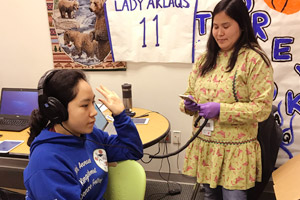
A student in the IPHW program demonstrates equipment at this worksite in the Physical Therapy Department at HHCC.
Native American students living on Arizona’s Hopi and Navajo Indian reservations are spending summer vacations discovering their vocation in life while providing hope for their communities.
The Indigenous Pride Health Worker (IPHW) program exposes high school students to professional health careers with the aim that they will eventually return to serve their people on the reservation. Begun in 2002 by the Health Promotion/Disease Prevention department at Hopi Health Care Center (HHCC) in Polacca, Ariz., IPHW is seeing some success in a region where students traditionally have not attended college. Fifteen IPHW students are in their second or third year studying for medical-related, undergraduate degrees.
A Critical Access Hospital, HHCC serves about 14,000 people living on the 1.5- million-acre Hopi Reservation and surrounding Navajo Reservation. Health care professionals are in short supply in this isolated desert area of northeastern Arizona. Recruiting professionals is extremely difficult, and turnover is high.
“We’re very remote,” HHCC CEO Daryl Melvin said. “We’re easily 100 miles from the nearest large community, and that’s only about 40,000 people. Grocery shopping is a two-hour trip here.”
Cultural influences compound providers’ challenges. On both reservations, traditional healing continues to be part of the culture. Poverty is rampant, many elderly patients do not speak English, and the encroachment of western civilization has introduced diseases and health care problems that once were foreign to the tribes.
IPHW organizers view the reservation’s young people as the most promising means of providing health care workers for the future. First, though, they have to convince students that college is part of their future.
Students must apply for the IPHW program and meet certain criteria to be selected. Once accepted, they spend part of their time shadowing a health care professional in their career choice and the remainder of the time taking educational classes. At summer’s end, they receive college credit and a stipend.
The experience introduces them to new life and job skill opportunities, provides academic support and involves them in community volunteer activities to build commitment to community, Melvin said. Class time also better prepares them for college—they learn to write resumes, research scholarship opportunities, improve study habits, etc. Northland Pioneer College, a two-year junior college, provides the educational component for IPHW students.
Once they go to college, IPHW continues to mentor the students. Of the 15 students in the 2007 summer program, five enrolled in college this fall for a total of 20 IPHW students now in college.
“That’s a huge deal here,” said IPHW director and family physician Dr. Anna Lewis. “Only about 10 percent go to college, and about 45 percent of them drop out after the first year. We’re trying to increase longevity.”
Lewis, who is used to working with a teenage shadow beside her, said the community is very supportive. “We ask patients if the student can accompany us and almost all of them agree. So these students really see all aspects of our work. Patients support it because they know how much we need more providers. They want these kids to get an education and return here in the future.”
Students can choose to shadow in a variety of areas, including patient-focused positions such as physicians, nurses, physical therapists and dentists as well as support areas like medical records and radiology.
“One of the most striking things about this program is the change we see over the summer,” Lewis said. “They come in shy, scared, their eyes downcast. By the time the program ends, they’re writing their papers and are bright-eyed and confident making presentations and talking to community members. It’s so exciting to see, and it happens every summer.”
Jamie Keith, whose parents teach on the reservation, attends Dartmouth College during the school year and interns with HHCC in the summer. Having grown up on the reservation, Keith demonstrates to students that they, too, can break the mold, Melvin said.
“It’s crucial just to get them to understand that they really can accomplish this,” Keith said. “The summer work experience prepares them for the next step. There are no bachelor’s level degrees available here so they have to leave the reservation to go to a four-year college. A job in health care also gives them a way to support themselves and their family when they return.”
HHCC has been able to create and run the program on a limited budget with mini-grants and private donations, with HHCC providing in-kind staff time, Melvin said. The 2007 budget was $28,000—$19,000 for student stipends, $5,000 for community college course fees and $2,500 for transportation, field trips and other costs. IPHW partners include the Workforce Investment Act of the Hopi Tribe, Hopi Foundation, Ottens Foundation, Harlem Children Society and Northern Arizona Health Education Center.
For more information, call the Hopi Health Care Center, Health promotions department at 928-737-6000 or email Dr. Anna Lewis at anna.lewis@ihs.gov.
Each year in late summer, the Bureau of the Census releases the official income and poverty figures for the previous calendar year. This event typically is followed by a spate of accompanying reports on how well American families are faring. This year is no exception. So, let us update our picture of how rural Americans are getting by.
Based upon data collected through the Annual Social and Economic Supplement (ASEC) of the Current Population Survey (CPS), the official poverty rate for 2006 was 12.3 percent. Some 36.5 million Americans were classified as poor. To be classified as poor, the income of a family of three would have had to be less than $16,079 last year.
Relatively speaking, rural Americans are doing less well financially than their urban peers. The poverty rate for Americans living outside of metropolitan areas was 15.2 percent in 2006, compared to 11.8 percent for those living in or adjacent to cities. This disparity is reflected in differences in median incomes for urban and rural areas. In the city, median income was $50,616. In the country it was $38,293, a decline of 1.3 percent over the previous year.
The rise in the number of uninsured Americans trumped poverty as the lead story this year. In 2006, some 47 million did not have access to health care coverage, some 15.8 percent of all Americans. Unlike 2005, the uninsured rate actually was higher in rural areas, increasing by 1 percentage point in just one year.
At the same time as the official poverty rates were released, William O’Hare, rural fellow at the Carsey Institute, issued an analysis that focused on the well being of rural children. Using data from the American Community Survey (ACS), he noted that 22 percent of rural children were poor according to recent data, up from 19 percent in 2000. For comparative purposes, the aggregate poverty rate for children was 17.4 percent in 2006.
Not surprisingly, where your rural community is located makes a difference to your likelihood of experiencing economic distress. About 27 percent of southern rural children lived in poverty, some five percentage points above the national figure. Across states the rates ranged from less than one in 10 (9.1 percent) of Connecticut’s rural kids to more than one-third of Mississippi’s rural children (34.7 percent). Poverty among children in rural communities rose in 37 of the 47 states where data was available.
Tapping yet another data source, the Economic Research Service (ERS), an analytic arm of the United States Department of Agriculture, has released additional information about the economics of rural communities. According to them, some one-third of rural families with children are what they consider in a low-income status. That holds for about one-half of rural families with young children and two-thirds of rural families headed by a single parent. Clearly, rural families with children are struggling to get by.
In some rural communities economic distress has been virtually a way of life for decades. The ERS analysis traces a pattern of persistent poverty counties (with 20 percent plus poverty rates over three decennial censuses). Visually, one can trace a more or less continuous path of such counties from rural southern South Carolina across the southern portions of Georgia and Alabama, then onto the Delta region of Mississippi onto good portions of rural Louisiana and Arkansas. If you add in Eastern Kentucky, and several counties dominated by Native Americans in the West, you have a depressing picture.
Why are so many struggling to get by in rural America? The ERS estimates that one-quarter of full-time and full-year rural jobs would not lift an average-size family there out of poverty. Further, some 42 percent of rural jobs are considered low-skill and therefore vulnerable to dislocation. And based on results from a survey conducted by the Carsey Institute, some 84 percent of respondents considered the lack of jobs in rural areas a serious problem. Moreover, 73 percent stated they would encourage a teen to move away for better economic opportunities.
This year’s spate of reports and analyses tends to confirm conventional wisdom—too many American families are struggling to get by, particularly in rural communities. While the cost of living is less outside of the city, by some 16 percent, earnings are even lower than the urban average, by some 25 percent.
Economic hardship, of course, is not uniquely a rural condition. Harvard Professor Elizabeth Warren argues that, no matter where they live, it now takes up to 75 percent of an American family’s resources to purchase what she calls necessities, up from 50 percent in 1973. Moreover, some four out of 10 American’s don’t have enough savings to cover one month’s expenses.
We are a wealthy country. However, access to resources is not evenly distributed geographically and too many of us are living on the edge of financial disaster.
Tom Corbett has emeritus status at the University of Wisconsin-Madison and is an active affiliate with the Institute for Research on Poverty where he served as Associate Director. He has worked on welfare reform issues at all levels of government and continues to work with a number of states on issues of program and systems integration.
Opinions expressed in this column are those of the author and do not necessarily reflect the views of the Rural Assistance Center.
Professor Corbett welcomes your feedback. Comments and reactions can be sent to: Corbett@ssc.wisc.edu.
Lots of Americans don’t have health insurance. The number now stands at about 47 million or 16 percent of the population, but I’ll bet you knew that. A similar number have health insurance ranging from token up to not-very-good and are considered “underinsured.” This includes families with enormous deductible policies sometimes called “save the farm” coverage. These are supposed to protect the homestead from seizure if a family member racks up a huge medical bill.
Considering the amount of attention focused on the uninsured and underinsured, it isn’t surprising that we’re hearing proposals to reduce their numbers. The proposals I’m hearing would get more people adequately insured. Several aim for health insurance coverage for all Americans, i.e., ”universal coverage.” Sad to say, even that laudable target is inadequate.
There are probably a variety of ways to get almost everyone covered. In the short run, money isn’t really the problem, at least in the first year or two. We’re already paying for care for a lot of uninsured folk through various sorts of safety net programs and cost shifting. And a substantial number of the uninsured are robust young adult males who are uninsured by choice. They use very little care except when they do something stupid.
In the mid-1980s we started tinkering with various aspects of health care: Medicare prospective payment for hospitals and, later, docs; waivers of various federal rules governing states’ management of Medicaid; sale of most nonprofit health insurance organizations to for-profit firms. In 1994 that tinkering came to a crescendo in several proposals for major changes in health care by members of Congress and the White House. All these proposals were defeated by claims that they were too complicated and that care would be controlled by government bureaucrats. The current proposals reflect that experience. Current proposals keep the current health care and insurance organizations, adding some new rules about who must buy and some new subsidies. No radical changes to scare anyone.
So what’s the problem? The problem is that our health care costs grow two to three times faster than any other major sector of the economy, and have been doing so for over 50 years. Any proposal that does not redirect current health spending, and contain future growth, will require new tax subsidies. How do you design a tax that will grow several times as fast as the economy? One way is to tax health spending. States that have tried that have heard their programs stigmatized as taxes on the sick. There aren’t many more, and none seem politically acceptable.
To summarize, major federally mandated structural change in health care to contain cost growth seems too radical, based on the ‘94-‘95 experience. Prospects for paying for heath care in the future in the absence of major reorganization are grim. Checkmate?
Maybe not. There is a pattern in federal Medicare legislation suggesting a third variation. Bluntly, first generation legislation promises to leave the current money distribution alone, and promises whatever else is necessary to get the legislation passed. As time passes and the need for change becomes undeniable to the general public, a “tipping point” is reached and new cost containment amendments are added.
For example, the 1965 Medicare legislation begins with reassurance to doctors and hospitals that they would continue to collect their “usually and customary” fees and charges. Twenty years later the Congress shifted hospital payments from what hospitals asked, to what Medicare, and Congress, felt was reasonable. Physician payments soon followed. The addition of prescription drug benefits to Medicare in 2003 prohibited Medicare from requiring drug companies to negotiate their prices. In 2007 Congress made the first attempt to mandate price negotiation between manufacturers and Medicare. That attempt failed but others are very likely to follow.
The process of trying to control costs without modifying underlying structure can become very convoluted. In 1998 Congress passed a law intended to bring Medicare payments to physicians into line with the growth of the economy overall. Beginning in 2002 the mandated rate setting method would have cut payments to doctors, so it has been overridden each year by various legislative strategies. Each year it becomes more difficult and expensive to “fix” the doctors’ pay problem. Bottom line: the “pass it now, fix it later” strategy is far from foolproof, but it may be the only short-term option.
We’ve all heard Churchill’s observation to the effect that “Americans can be counted on to do the right thing when they’ve exhausted all the other possibilities.” In the case of health care, we have proven very adept at devising other possibilities.
Wayne Myers, a pediatrician, founded the University of Kentucky Center for Rural Health and served as its director. He also served as director of the Office of Rural Health Policy in the Department of Health and Human Services' Health Resources and Services Administration. He is a past president of the National Rural Health Association.
Opinions expressed in this column are those of the author and do not necessarily reflect the views of the Rural Assistance Center.
Dr. Myers welcomes your feedback. Comments and questions can be sent to him at myers@raconline.org.
Robert C. Bowman, M.D., is one of the country’s leading researchers in rural medical education. He is the North American Regional Editor for the journal, Regional and Remote Health, the Founding Chair of the Rural Medical Educators Group of the National Rural Health Association, and has served as chair of the Society of Teachers of Family Medicine (STFM) Group on Admissions and Group on Rural Health. In the past five years he has been immersed in national data regarding the choice of family medicine, rural practice, birth origins and admissions efforts. He runs the web site, The World of Rural Medical Education, which offers findings from his research as well as tools, links and other information related to creating a better distribution of physicians in the United States.
Bowman was born in Texas City, Texas, and trained at Baylor College of Medicine in Houston and the McLennan County Family Medical Residency Program in Waco. He chose rural practice before teaching, serving as a solo rural family physician in Nowata, Okla. from 1983-1987. He credits that experience and Tom Bruce's book, Improving Rural Health, with his moving toward a career in rural medical education. He taught at Baylor and East Tennessee State, directing the rural fellowship and initiating the Minifellowship in Rural Family Medicine. He is the Director of Rural Health Education and Research for the Department of Family Medicine at the University of Nebraska Medical Center. Bowman lives in Omaha. He has three children and two grandchildren. His wife, JoAnn, is a school teacher. He says that gardening and basketball have given way to his more recent research efforts.
Could you summarize what your research has revealed about recruiting and retaining rural physicians? I think my basic message is this: To distribute physicians outside of major medical center locations the United States must coordinate improvements so that more medical students are admitted from origins outside of major medical centers (lower and middle income origins), more medical students are trained outside of major medical centers (about 98 percent of training is currently done there), and lower and middle income populations receive health policy support sufficient to access health care in areas outside of major medical center locations. The United States has consistently distributed physicians when following these guidelines. It has demonstrated the ability to distribute physicians, but is currently not choosing to do so.
You used the term “major medical centers.” Is that your term? If so, can you explain it? The definition is mine. Major medical centers are defined as medical school zip codes or zip codes with 75 or more physicians.
My work starts with concentrations of physicians, integrates geography and income distributions, and then moves toward understanding how concentrations of health care and people are related. Areas with high poverty, low income and fewer physicians have unique problems and often fail to gain designations or grants despite greater need. When you know where physicians started (birth geography, income, language, race, ethnicity), where and how they were trained and how policy interacts with these areas to concentrate physicians, then you can understand physician distribution. Physicians naturally concentrate without active decisions to oppose this in admissions, in training, in choice of family medicine or in distribution of funding outside of major medical centers. Similar skewed distributions are common in education and economic development.
Those born, raised, educated and trained in major medical center environments for the first 30 years of life are not likely to choose the family medicine career most associated with practice outside of major medical centers and they are least likely to choose locations outside of major medical centers. (For a more detailed explanation, see Major Medical Centers).
Why do medical schools need to admit more students from lower income households? Current admissions include medical students from the top income, most urban, most professional families—a group of 70 percent are admitted from the top 20 percent income levels. Humble origin (lower and middle income) children are the most likely to become physicians that are oriented toward service and people, that choose family medicine, primary care, women's health and psychiatry, and that are found in rural and lower and middle income areas of the nation, basically those outside major medical center locations. Social and geographic distance prevents admissions of humble origin children.
What do you think is a major factor that prevents rural and lower income students from entering medical school? For a number of reasons, standardized test scores are "worshipped" and the consequences are more professionals with narrow origins, fewer physicians remaining in their states to practice and more difficulty distributing physicians beyond their major medical center origins. The standardized test score and ranking systems of the nation reveal more about status and parents than quality in individuals. Admissions of rural-origin students to medical school have declined for decades. Medical students from parents making over $100,000 increased from 24 percent to 43 percent from the 1997 matriculants to the 2004 matriculants. This means that 3,000 more highest income medical students have replaced 1,500 lower-income and 1,500 middle-income medical students. At the same time, both household and median family income levels in the nation have increased only two to three percentage points over this time. The top income medical students have basically doubled over a seven-year period with relatively little change in income levels in the United States.
Are you saying that medical schools should lower their admission standards in order to admit more low-income and rural students? No. Medical schools must raise their admission standards by admitting the medical students that place far more emphasis on the most important part of being a physician—communication skills and the ability to relate to their patients. Medical schools are actually lowering their standards by admitting only those with extremes of standardized testing and by discouraging those with more average scores.
How could they do this without lowering their standards for all students? Standardized test scores mainly predict student performance, not physician performance. The Medical College Admission Test (MCAT) predicts student performance for the first one or two years after the test and performance of a standard student, not those geographically, linguistically, culturally and socioeconomically different. When medical schools select a reasonable threshold score that predicts graduation from medical school (based on past data) and then picks the students that are most likely to become the best physicians, this is a much better process for choosing the best physicians, not the best first-year medical students.
Do you envision students entering with lower test scores being given remedial courses or extra help? Remediation is easy in the areas of academics. Remediation is difficult in the area of deficient people skills. Lower test scores typically prevent admission entirely. There are few measures of people skills and those with marginal or poor people skills can gain admission and become physicians. The correct question for those choosing the nation’s future physicians is “Who will be the best physician in 10 or 20 years, not just the first year of medical school?” As in many cases, by asking the right question, the answers fall into place. (For more on this topic, see the web sites, MCAT Central and Driving Difficulty or Distinction).
Do you know of any schools, programs or states that are working to bring in more rural and lower income students into medical school? The schools with lower MCAT scores have adapted different types of admissions efforts. Schools graduating the most family physicians and rural physicians are evident in these areas. University of Minnesota Medical School–Duluth has perhaps done the most to specifically select rural family physicians. Mercer University School of Medicine had efforts in place up until recently. Indications can be seen also in older age admissions and the University of New Mexico leads allopathic schools in this area. Osteopathic schools have more of a focus on the student and less focus on scores and have top levels of older graduates, family physicians, rural physicians and underserved physicians. The six osteopathic public schools as a group lead the nation in these areas. The United States seems to have lost the lesson of public support to influence medical education and help medical schools meet state health care needs.
Does the issue of physician distribution have any effect beyond health care access?
States that invest in children, education and better distributions of opportunity graduate more family physicians, teachers, nurses and public servants. Basically they are more efficient. States with fewer concentrations of physicians in major medical centers have lower health care costs. States and cities with great concentrations have great inequities between rich and poor. These are the locations with both the highest and lowest outcomes in education, health, public security and other areas. The tremendous costs of poor outcomes usually outweigh the benefits of those with top outcomes.
What do you think will be the major issues and challenges in rural health care in the next five to 10 years?
Without addressing health policy, primary care levels will deteriorate. More and more nurse practitioners and physician assistants will transition away from rural locations and away from primary care. Pediatric and internal medicine levels will decline. Increases in osteopathic numbers will help, but osteopathic family medicine levels will decline. International medical graduates will help, but again health policy will shape the physicians that will choose family medicine, those that will remain in primary care and those that will distribute to rural locations. Rural major medical centers and those able to make the transition to larger centers will do well and will capture market share from smaller locations with intermittent workforce. States and medical schools and communities that work together will be in the best position to meet these situations. Those that fail to cooperate will have more difficulty. This will be even more important at the local level where even more cooperation will be needed from physicians, practitioners, administrators, hospitals and the community.
Do you struggle to keep up-to-date on the latest news about rural health and human services? Are you missing opportunities to comment on proposed federal regulations or to attend events being held near you? The Rural Assistance Center (RAC) web site’s News and Events section may be just what you need. RAC staff search for rural-relevant news and events daily and make it available for you to access quickly and easily on the web site.
Recent News
Recent news on the RAC site includes articles about health, human services and rural life from newspapers, magazines and other media outlets. These articles tell of new research and developments, feature model programs and best practices, and highlight problems and disparities. In addition, information and alerts directly from numerous state and national organizations as well as federal agencies are featured. This keeps readers informed of regulations and policy that can significantly affect rural facilities and agencies.
Federal Register News
The Federal Register is a very important source of information related to federal rules, regulations and notices. Unfortunately, it can be very time consuming to comb through the Federal Register on a daily basis. That’s why the RAC staff does it for you. Each day, we identify and post only the entries that might be of interest to people involved in rural health and human services, including:
Funding opportunities;
Final rules (regulations);
Proposed rules with request for comment;
Agency information collection activities with comment request;
Notices of public meetings.
Calendar of Events
RAC’s calendar of events is an extensive listing of events that might be of interest to you including dates, locations, contact information and web sites to find out more about each particular event. You can browse for events by month or by your state. Events listed include conferences, workshops, meetings, webcasts and conference calls related to health, human services and rural issues. Browsing the calendar of events can keep you from missing out on great opportunities to network and learn.
For real-time updates on news items and events added to the RAC web site, consider subscribing to RAC ’s RSS feeds. (For more information about RSS feeds, please see, http://www.raconline.org/rss/.)
Reprint Policy: Articles, photos, and charts appearing in the Rural Monitor may be reprinted with the permission of the Rural Assistance Center and proper citation. For permission, please contact ksande@raconline.org.