


Rural Schools and Health
While primarily focused on education, rural schools also play an important role in the health and wellness of students and the community. Working on health-related initiatives makes sense for rural schools as physical and mental health status, physical activity, and good nutrition all impact how students learn. Schools serve as an important community resource and can engage in health-related activities such as:
- Teaching children about health and wellness topics
- Providing nutritious meals and snacks
- Providing opportunities for and education related to physical activity
- Discouraging and preventing bullying
- Serving as a location where healthcare is provided
- Serving as a location where human services are provided to address the social determinants of health
- Serving as an advocate for children with special health needs
- Providing counseling and resources related to mental health and emotional well-being
Frequently Asked Questions
- What role can rural schools play in improving the health of their students?
- How can schools promote population health within their communities?
- What health education and prevention programs can be implemented in a rural school to improve students' knowledge of how to maintain their own health?
- How can rural schools work to address and prevent adverse childhood experiences (ACEs)?
- What role can schools play in providing human services to address social determinants of health?
- How can rural schools provide mental health support for their students?
- How can rural schools provide children with healthy and affordable food options?
- What are strategies that rural schools can use to increase the amount of physical activity their students get during the school day?
- How has COVID-19 impacted rural schools?
- How do school-based health centers and community schools impact population health in rural areas?
- What funding programs are available to support school-based health services?
- How are schools addressing the shortage of health professionals and getting students interested in health careers?
What role can rural schools play in improving the health of their students?
Schools play a significant role in promoting the health and safety of students. Ideally, rural schools will provide nutritious meals, encourage physical activity, contribute to healthy social-emotional development, and strive to maintain a safe physical environment where students can learn.
One strategy some rural schools have implemented is the creation of a School Health Advisory Council or a School Wellness Committee, which works to promote a healthy and safe school environment for students and staff. This council often has input from students, parents, teachers, and school administrators to identify barriers and solutions to improving the health and well-being of students.
The Centers for Disease Control and Prevention (CDC) promotes a coordinated school health approach that integrates health-promoting initiatives in schools and in policies that support students' well-being and health. CDC has expanded this methodology to the Whole School, Whole Community, Whole Child (WSCC) collaborative model, engaging leaders from the health, public health, education, and school health sectors to unify and strengthen their approach to improve students' learning and health, as well as engaging students as active participants. The WSCC model highlights ten elements supporting a whole child approach to education:
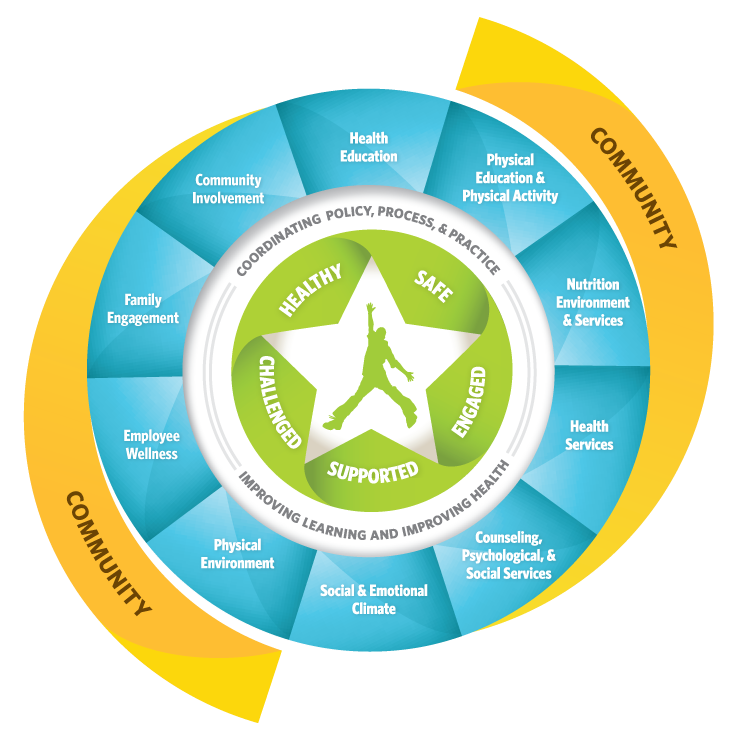
- Health education
- Social and emotional school climate
- Physical education and physical activity
- Health services
- Nutrition environment and services
- Counseling, psychological, and social services
- Employee wellness
- Family engagement
- Community involvement
- Physical environment
The CDC and Association for Supervision and Curriculum Development (ASCD) provide more information about the Whole School, Whole Community, Whole Child model. For other examples of evidence-based programs schools can implement, see How Can Rural Schools Address Obesity? in our Rural Obesity Prevention Toolkit.
Schools can serve as a location for providing students with counseling and behavioral health services. According to a CDC report, the percentage of children with diagnosed mental, behavioral, and developmental disorder (MBDD) is consistently higher in rural areas. For illustration, 18.6% of children aged 2-8 living in small rural areas in 2011-2012 had a reported MBDD diagnosis compared to 15.2% of children of same age group in urban areas. Mental Health Treatment Among Children Aged 5–17 Years: United States, 2021 reports that 19.1% of children aged 5-17 in nonmetropolitan areas have received mental health treatment, compared to 14.9% of children in medium or small metropolitan areas and 14% of children in large metropolitan areas. Schools are the most common location for children to receive mental health services. Providing Access to Mental Health Services for Children in Rural Areas identifies ways in which school-based health centers can provide these services. Our Mental Health topic guide has resources on how schools can take action to prevent suicides.
Schools can also provide resources for students with special behavioral healthcare needs. According to Mental Health Surveillance Among Children—United States, 2013-2019, 0.4% of rural children aged 3-17 have reported Tourette syndrome, and 2.8% have reported autism spectrum disorder. Schools are often the access point for rural students who need additional services.
Oral health is another area where schools can play a role in improving children's health and help them develop healthy habits. School-based dental programs can provide dental screenings, fluoride varnishes, dental sealants, and a variety of oral health education to students without them having to leave the school. For examples of what some rural schools have implemented, see the School-based Model section of our Rural Oral Health Toolkit.
In addition to school health promotion initiatives and policies, some rural schools are able to employ school nurses who provide some health services. They work with parents, teachers, and other health professionals to provide a plan for the health needs of the school. School nurses provide services for students with special health needs, such as prescription medications, asthma inhalers, and catheters so they can attend school. They also provide health promotion activities and education including:
- Fitness and nutrition education
- Tobacco use prevention
- Sexually transmitted disease prevention
- Teen pregnancy prevention
- Hearing and vision screenings
In rural schools, nurses often fill multiple roles including clinician, administrator, record keeper, and grant writer.
The 2015 NASN School Nurse Survey reports on a survey of school nurses in all 50 states. The majority of school nurses who responded to the survey were employed by a public school district and their position was funded by the regular education budget. Just over 30% of survey respondents worked in at least one school in a rural area. According to School Nurses in U.S. Public Schools, rural schools were the least likely to staff a full-time or part-time nurse, with 78% of rural schools having access to a nurse compared to 84% of town and suburban schools.
The 2016 School Nurse Workforce Study reports 25% of America's schools do not employ a school nurse, with only 39% having a school nurse available at all times during the school week. A Robert Wood Johnson Foundation article warning of the consequences of a school nurse shortage states:
“Many rural counties lack even a single physician or nurse practitioner, so the school nurse—if there is one—becomes the 'frontline expert' during the school year and sometimes during the summer too…”
Some schools may also house a school-based health center, provide human services that impact social determinants of health, or utilize a community school model, all strategies that directly address the health needs of students.
How can schools promote population health within their communities?
Population health is defined as the health outcomes of a group of individuals, such as the residents of a specific rural community. Schools can promote population health by providing health promotion and disease prevention education to their students, staff, parents, and other community members. The prevention of obesity, diabetes, and other chronic diseases can have an impact on the whole community's health and vitality.
Schools can also partner with health departments, businesses, and community groups to support physical activity programs by allowing community members to use school gymnasiums and playgrounds when school is not in session. In small rural communities where funding for gymnasiums, exercise equipment, and playground equipment is limited, it is important for community organizations to work together to provide opportunities for physical activity.
Rural schools can motivate staff, students, and community members to increase physical activity by creating walking clubs, running clubs, or other opportunities for group exercise. Get Out & Get Moving: Opportunities to Walk to School through Remote Drop-Off Programs, describes programs in which buses or parents drop students off at approved and safe locations a half- or quarter-mile from school so they can walk the rest of the way and increase their daily exercise. Similar initiatives can provide physical activity opportunities for families and community members.
Another strategy to increase physical activity is by transitioning cement areas into painted play spaces. These areas, which incorporate painted-on game and activity markings such as hopscotch and four square, have exhibited positive impacts for children, schools, and communities as a whole, and it is a way to turn an unused area into a worthwhile investment that can provide long-lasting population health benefits. See Painted Play Spaces: Playground Assessment and Planning Toolkit for an example of how to implement painted play spaces.
Rural schools can also provide health fairs and wellness days for staff and students to gain awareness of health issues and inspire individuals to take an active role in their healthcare.
What health education and prevention programs can be implemented in a rural school to improve students' knowledge of how to maintain their own health?
There are many health education programs that rural schools can implement to improve students' knowledge of how to maintain their own health. For example, in South Dakota, the Harvest of the Month Program encourages schoolchildren to make healthy eating choices by tasting different fruits and vegetables. Students in the program can sample new foods and are encouraged to make healthy food choices at school and at home. Exposing young children to a variety of nutritious foods in a positive setting will help them improve life-long healthy food behaviors. The Harvest of the Month program has been implemented in other states as well.
CATCH (Coordinated Approach to Child Health) is a popular health education program that introduces healthy eating and physical activity options during the school day and encourages positive behaviors outside of school.
Rural schools also have the opportunity to promote drug and alcohol use prevention programs. The 2020 Rural Monitor article Drug Education and Cessation Programs Help Teens Avoid or Quit Vaping discusses programs to help students abstain from tobacco and provide support for quitting.
Rural areas that struggle with high prevalence of chronic disease can take steps within schools to provide health and wellness education. The 2021 article Cancer Curriculum for Appalachian Kentucky Middle and High Schools discusses the creation of a cancer curriculum in response to high disease and mortality rates in Appalachian Kentucky linked to health and lifestyle behaviors. The program aims to increase cancer literacy and influence lifestyle choices.
It is important for rural schools, teachers, and coaches to take an active role in preventing injuries, particularly brain injuries, during gym classes, school practices, and school sporting events. Teachers and coaches can educate student athletes and parents about the dangers of head injuries and can teach and promote safe playing techniques. More information is available from the Centers for Disease Control and Prevention regarding brain injury safety while playing sports and monitoring the health of student athletes who have symptoms of a concussion.
Schools can also be involved in helping students navigate brain injury recovery. An April 2020 Rural Monitor article, Concussion in Rural America: Experts Detail Injury and Recovery of Traumatic Brain Injury, describes Remove/Reduce, Educate, Adjust/Accommodate, Pace (REAP), a community-based model developed to help with concussion management. REAP was originally created to be used by communities with scarce resources, including those in rural settings. Although the tool was first established in Colorado, according to the Rural Monitor article, it can and has been modified for use by schools and other organizations in various states.
Several examples of wellness programs for children can be found in our Models and Innovations under the topic of Wellness, health promotion, and disease prevention and narrowing by topic to “Children and youth”.
How can rural schools work to address and prevent adverse childhood experiences (ACEs)?
Adverse childhood experiences (ACEs) can have great impacts on children's growth and development. The National Survey of Children's Health (NSCH) data brief Rural/Urban Differences in Children's Health states that, compared to children from urban areas, children from large and small rural areas were more likely to experience the following ACEs in 2017-2018: parental divorce, living with someone who engaged in alcohol or other substance misuse, having an incarcerated parent or guardian, living with someone who had a mental illness, or witnessing parental violence. ACEs can cause mental, emotional, and physical health issues for impacted children and are likely to impact their health as adults. According to the data brief, depression, behavior problems, and anxiety were all more prevalent in children aged 3-17 who were from large and small rural areas than those from urban locations.
Meeting Students Where They Are: Trauma-Informed Approaches in Rural Schools states there is a lack of resources and research related to trauma-informed approaches and social-emotional learning in rural schools, where the need is highest. Schools that take a trauma-informed approach to helping children may be able to mitigate potential issues of children who have been impacted by ACEs. The Substance Abuse and Mental Health Services Administration defines trauma-informed care as:
“A program, organization, or system that is trauma-informed:
- Realizes the widespread impact of trauma and understands potential paths for recovery;
- Recognizes the signs and symptoms of trauma in clients, families, staff, and others involved with the system;
- Responds by fully integrating knowledge about trauma into policies, procedures, and practices; and
- Seeks to actively resist re-traumatization.”
The Rural Monitor article, Confronting Adverse Childhood Experiences to Improve Rural Kids' Lifelong Health, discusses the Compassionate Schools initiative that was implemented in Buncombe County, North Carolina. The program works to recognize signs of trauma in children and respond to their needs. In addition, the program teaches students skills such as resiliency and self-regulation. The article also details the Fostering Futures program of Menominee Nation in Wisconsin, a collaborative effort involving numerous agencies, including the local school district, to address and prevent ACEs. The program has increased behavioral health visits, decreased school suspensions, and increased graduation rates. For additional information about the program, see Fostering Futures in Menominee Nation in the Models and Innovations section.
In Exploring the Rural Context for Adverse Childhood Experiences (ACEs), the National Advisory Committee on Rural Health and Human Services recommends telehealth-supported school-based health centers to increase access to integrated primary care and behavioral health services in rural areas.
What role can schools play in providing human services to address social determinants of health?
Social determinants of health (SDOH) can negatively impact academic participation and success, which may in turn lead to poorer health outcomes. Education and Health: Long-Term Trends by Race, Ethnicity, and Geography, 1997–2017, a publication from the Robert Wood Johnson Foundation and Urban Institute, states that less education is associated with lower life expectancy, greater risk for chronic conditions, and poorer self-reported health. These health disparities are exacerbated in rural communities, with more reports of fair or poor health in 2017 among rural adults with some (9.5%) or no college (18.7%) than among urban adults with some (6.3%) or no college (14.5%). To help address SDOH and enable students to pursue postsecondary education, schools can provide human services or refer students to outside agencies for needed assistance. According to an issue brief from the U.S. Department of Education, common social services provided by schools include:
- Mental health services
- Health services
- Assistance to address transportation, shelter, clothing, and other material needs
- Parent/family engagement
- Parent/family support to increase awareness of child's progress in school
- Child care for teenage parents
- New American services
- Other services
Unfortunately, schools in rural settings are less likely to offer social services compared to their nonrural counterparts. The issue brief states that 97% of suburban schools and 98% of city schools provided one or more social services, while only 93% of rural schools offered these services in 2014-2015.
For information about how educational attainment affects rural residents' health, see the Social Determinants of Health topic guide.
How can rural schools provide mental health support for their students?
Addressing mental health needs is an important factor for academic success, safety, and general health and wellbeing of rural students. According to the 2022 School Pulse Panel, 61% of rural schools report an increase in students seeking mental health support since the beginning of the COVID-19 pandemic. However, only 33% of rural schools hired more mental health support staff during the same time period. A shortage of mental health professionals and inadequate funding are cited as the main reasons for the lack of mental health support staff.
Rural schools often report more issues related to poor mental health and bullying, particularly for underrepresented groups. Student Reports of Bullying: Results from the 2022 School Crime Supplement to the National Crime Victimization Survey states that 23.8% of rural students report having been bullied compared to 19.0% of students in cities. According to the 2021 National School Climate Survey:
“LGBTQ+ students in rural schools faced more hostile school climates than students in urban and suburban schools including experiencing higher rates of biased language, victimization, and anti-LGBTQ+ discriminatory school policies and practices.”
The climate survey suggests mental health benefits of having more school resources and supports for LGBTQ+ students, especially in rural areas where the need is the greatest.
Rural schools have an opportunity to positively impact the mental health of their students and provide necessary supports. However, rural communities struggle for resources to provide these supports. According to Report on Indicators of School Crime and Safety: 2022, 61% of city schools and 60% of suburban schools were able to provide diagnostic mental health services to students, compared to 44% of schools in rural areas. Even if mental healthcare is available, students in rural areas may avoid accessing it due to stigma or privacy concerns.
Technology-based and other service delivery models can help provide necessary mental healthcare in rural schools. According to a 2022 study, utilizing online training in rural communities can provide the necessary technical assistance to better prepare behavioral health staff who serve rural students. A 2022 policy brief, Focus on School-Based Mental Health for Rural Central Virginia's Youth, provides the following recommendations to improve mental healthcare in rural schools:
- Funding for mental healthcare in rural schools
- Mobile crisis response units
- Professional support for specialty behavioral health staff
- Incentives for mental health professionals to work in rural, underserved areas
The 2019 report Promoting Positive Mental Health in Rural Schools indicates that availability, accessibility, and acceptability are the main barriers for students who live in rural, isolated, and underserved areas in obtaining mental healthcare. Rural schools have an opportunity to intervene early and respond to a student's mental health needs, which is “critical to a student's overall well-being.” A Rural Therapist and School Program Addresses Teen Mental Health from the Rural Monitor discusses proactive approaches to support the mental health of students in rural schools. Another resource for rural schools is Mental Health First Aid from the National Council for Mental Wellbeing, which provides education to empower all staff to identify, understand, and respond to mental health crises, which can be a crucial first step in addressing the mental health issues of students, especially for rural schools that may lack mental health professionals on site. For more information on mental health in rural areas, see our topic guide Rural Mental Health.
How can rural schools provide children with healthy and affordable food options?
Access to nutritious foods is essential for both academic success and maintaining health and wellness. Rural schools can promote healthy eating through the curriculum and local food programs, though it can be a challenge for rural communities to secure locally sourced food. According to Daily Access to Local Foods for School Meals: Key Drivers, schools in rural counties had the lowest probability of serving locally grown foods.
USDA's Tools for Schools provides subject-specific resource materials to help schools meet federal nutrition and compliance standards, such as nutrition education curricula and literature as well as food buying guides. Tools for Schools also offers information on obtaining local foods, enhancing school lunches, school wellness policy, and regulatory requirements.
The National Farm to School Network is a movement to bring more local food into schools and to teach children about where their food comes from. The network encourages schools to purchase, prepare, and serve locally grown items. The program also supports bringing students to local farms to teach children about the importance of nutritious food and local farming.
The Community Eligibility Provision (CEP) allows high-need schools who meet eligibility requirements to serve meals to all students at no cost regardless of family income. The CEP Opportunity Finder from No Kid Hungry shows schools that are eligible for CEP.
EatMoveGrow (EMG) aims to create a culture of health in rural schools by focusing on healthy lifestyles and environments, social-emotional learning, and oral health. EMG states that one third of the calories children eat come from high calorie and high fat foods. The EMG Fruit and Vegetable Superheroes activities help students understand nutrient dense foods in a fun and accessible way.
If school land is available, planting school gardens provides an opportunity for students to be involved in growing different types of fruit and vegetables as well as learning where their food comes from. School gardens are an excellent source of nutritious items for food service staff to prepare for students and school staff members. A 2019 Preventing Chronic Disease article, Gardening for Health: Using Garden Coordinators and Volunteers to Implement Rural School and Community Gardens, highlights an intervention to improve fruit and vegetable consumption by creating community gardens with school and community volunteers.
There are several programs available through USDA's Food and Nutrition Service which provide nutritious meals and snacks to students including:
-
School Breakfast Program
Assistance to states to operate breakfast programs in schools and residential childcare programs. -
National School Lunch Program
Nutritious low-cost or free lunches to children in schools and residential childcare programs. -
Special Milk Program
Reimburses schools for milk they serve to children who do not participate in other federal meal service programs. -
Child and Adult Care Food Program: Afterschool
Programs
Nutritious meals and snacks for afterschool programs served in a group setting to children and teenagers. -
Summer Food Service Program
Provides funding to local sponsors who want to combine a meal program with a summer activity program for children 18 years old and younger.
For examples of strategies that rural schools can use to improve healthy food choices, see our Models and Innovations regarding food and hunger. Additionally, Farm to School Models are discussed in our Social Determinants of Health in Rural Communities Toolkit with resources and program examples.
What are strategies that rural schools can use to increase the amount of physical activity their students get during the school day?
Children need quality physical activity throughout their day to lead healthy lives, to learn, and to prevent obesity. A 2015 literature review of childhood and adolescent obesity indicates children aged 2-19 living in rural areas have a higher rate of obesity and a 26% greater chance of becoming obese when compared to urban children. Increasing physical activity to 60 minutes per day is a key obesity-prevention strategy, and children who are given time at school recess or in physical education classes are better able to meet this goal.
Rural schools are an ideal location to promote and foster physical activities and can serve as a community resource to support afterschool physical activities. There are several model programs that address physical activity and healthy eating in rural schools. According to an April 2016 Rural Monitor article, Meeting the Needs of the Whole Child through CATCH, the CATCH (Coordinated Approach To Child Health) program is very adaptable to a rural setting and can be modified to support the needs of both the school and the local population. This program focuses on creating healthy behaviors in children by enabling them to identify nutritious foods and to increase their time spent engaging in physical activity. This program has been successfully established in several rural settings. For example, the CATCH Early Childhood Pre-K program in Illinois, which is featured in the Rural Monitor article, provides a curriculum that includes stories, games, puzzles, and equipment to encourage healthy food choices and physical activity in preschool children.
Brain breaks or brain energizers are short pauses during traditional classroom instruction to allow students time to move, and they are a great way for schools to add small amounts of physical activity to the school day. Short activity breaks like these can improve well-being and concentration without losing valuable educational time with students.
For more information on physical activity and obesity prevention, see our Rural Obesity Prevention Toolkit.
How has COVID-19 impacted rural schools?
The COVID-19 pandemic has had a significant impact on rural communities and the operations of rural schools. Along with the more immediate screening, quarantine, and vaccination challenges experienced during the height of the pandemic, many schools report long-term impacts. According to the National Center for Education Statistics (NCES), public schools have reported worsening student behavior, increased chronic absenteeism, and the need for more mental health and student support staff. A Rural & Minority Health Research Center Findings Brief states that though there were no significant changes for rural children related to the prevalence of anxiety, depression, and behavior prior to and during the pandemic, there was an increase in symptoms during 2020 for both urban and rural children who already had a mental health condition prior to the pandemic.
Despite these challenges, the pandemic has in some cases prompted rural communities to leverage resources and seek creative solutions to better the health of students. Supporting Schools at a Distance: A Discussion with Two Rural Psychologists on Challenges and Opportunities During the Covid-19 Pandemic considers the challenges of sudden and unexpected remote counseling, but the article also explores the way telehealth appointments helped many students access mental health support when they would not have been able to in face-to-face environments. As more rural schools find strategies to use telehealth as an option for their students, they may be able to overcome burdens such as lack of behavioral health specialists, transportation issues, and stigma.
Due to the increase in school funding during the pandemic, some rural schools were able to make long-term improvements to their buildings and services. Educational technology, ventilation systems, and an increased awareness for mental health support are some of the positive responses to COVID-19 challenges. According to Culturally Affirming Care for Rural Students During the Pandemic: A Karuk Perspective, the pandemic increased awareness around the holistic role of schools to provide students with access to reliable internet, food, healthcare, and more, particularly for those who come from disadvantaged populations.
The pandemic also illuminated disparities for rural populations related to mitigation efforts. Ventilation Improvement Strategies Among K–12 Public Schools — The National School COVID-19 Prevention Study, United States, February 14–March 27, 2022 states that rural and mid-poverty schools were least likely to implement resource-intensive ventilation systems, and the article therefore recommends support for rural schools to find and apply for applicable funding given the success of ventilation strategies to reduce transmissible disease. Disparities in Implementing COVID-19 Prevention Strategies in Public Schools, United States, 2021–22 School Year found that rural schools had lower odds of utilizing high-efficiency particulate air (HEPA) filtration systems or providing COVID-19 vaccines to students, staff, and families. Ensuring rural schools have adequate health infrastructure and personnel may help mitigate these disparities.
How do school-based health centers and community schools impact population health in rural areas?
School-based health centers (SBHCs) can provide access to healthcare for students who may not otherwise receive care. Rural students may face barriers to accessing healthcare services, including long distances to providers, lack of reliable transportation, work demands of students' parents, poverty, lack of health insurance, and the cost of healthcare. School-based health centers often operate as a partnership between the school and a community health center, hospital, or local health department to improve the health of students, as well as the community as a whole.
SBHCs provide a variety of services to improve the overall health of students and their family members, including primary care, immunizations, health screenings, and health education. Some SBHCs provide additional services such as mental health services, vision and hearing examinations, dental services, substance abuse services, and reproductive health services. Twenty Years of School-Based Health Care Growth and Expansion states that as of 2016-2017, SBHCs provided primary care, mental healthcare, and dental care to nearly 11,000 schools and 6.3 million students, and the number continues to grow. Part of the growth of SBHCs has come alongside the growth of telehealth. According to The Use of Telehealth in School-Based Health Centers, the percentage of SBHCs using telehealth grew from 7% in 2007-2008 to 19% in 2016-2017. The concurrent growth of both SBHCs and telehealth provides access to rural and underserved children who may otherwise not receive healthcare. The School-Based Telehealth Playbook from the School-Based Health Alliance provides information on how to design, implement, and operate a SBHC telehealth program.
According to The Complementary Roles of the School Nurse and School Based Health Centers from the National Association of School Nurses, having a SBHC improves students' access to healthcare services, but the center does not necessarily take the place of a school nurse. School nurses are employed by the school district and serve all students. School-based health centers, on the other hand, are usually run by a community health center and students must enroll in the clinic to receive services. Collaboration between school nurses and health professionals at the SBHC is important for improving the well-being and education of rural students.
For information on how to start a school-based health center, HRSA's FY 2023 Competitive School-Based Service Expansion website has information regarding how to apply. The School-Based Health Alliance offers Quality Counts: Sustainable Business Practices QI Toolkit to help SBHCs build a stable foundation to ensure long-term viability.
Another model to improve rural access to healthcare is the community school. According to the National Education Association, community schools are built specifically to provide services that meet the specific needs of their local communities. Services might include food security programs, social and behavioral health support, college readiness programs, and more. In rural areas, healthcare access is often a need that can be provided by a community school. Implementing Full-Service Community Schools in a Rural Setting: Early Lessons from Leslie County, Kentucky provides a case study of integrating social services and healthcare into school districts.
What funding programs are available to support school-based health services?
The Federal Office of Rural Health Policy offers the Rural Health Care Services Outreach grant program. This program supports collaborative projects that demonstrate effective models of outreach and service delivery in rural communities. Funding can be used to address school-based health services including health promotion and disease prevention activities.
Many schools rely on a mix of public, private, and nonprofit funding to support a school-based health center (SBHC). According to the Twenty Years Of School-Based Health Care Growth And Expansion, 46% of SBHCs in the U.S. receive funding from the federal government. Top sources include HRSA's School-Based Service Expansion Program, HRSA's Service Area Competition Funding, and Title X Family Planning funding. Private foundations contributed financial support to 40% of SBHCs. Also, the majority of SBHCs receive state dollars for operation. States can direct funds to SBHCs from various sources including the general fund, taxes, and the federal Maternal and Child Health Block Grant.
Other funding programs for school-based health may be found on our list of funding opportunities related to schools, which includes federal, state, and private foundation funding opportunities. Information regarding the sustainability of grant-funded school programs can be found in the Planning for Funding and Sustainability module of the Rural Community Health Toolkit and the Sustainability Planning Tools page.
How are schools addressing the shortage of health professionals and getting students interested in health careers?
In looking at the health of the community long-term, many rural schools realize the need to expose students to healthcare careers, in hopes of “growing their own” healthcare providers that will stay in their rural community and provide healthcare for the community's citizens down the road. To do this, many schools partner with Area Health Education Centers (AHECs), which provide health career education programs for students.
AHEC initiatives address healthcare workforce issues by exposing students to career opportunities. AHECs also help host career fairs for schools to showcase the variety of careers within the healthcare industry. For example, the West Virginia AHEC is involved in health workforce pipeline programs including:
- High school health career clubs that meet monthly
- Shadowing opportunities for high school students at Federally Qualified Health Centers (FQHCs) and their affiliated school-based health centers
- Health career fairs that target middle and high schools
- Opportunities for students to learn about medical procedures using robotic simulators
- Assistance to students preparing for college admission tests
The National AHEC Organization provides a directory of contact information for AHECs by state.