


Scholarships, Loans, and Loan Repayment for Rural Health Professions
Rural areas face a documented shortage of essential healthcare professionals, especially in primary care fields. According to a 2021 report by the Association of American Medical Colleges, The Complexities of Physician Supply and Demand: Projections From 2019 to 2034, the demand for primary care physicians, specialists, and other healthcare professionals is only expected to grow. In addition, COVID-19 has heightened awareness of disparities in healthcare access and amplified workforce shortages in rural and underserved areas.
The rising cost of education directly impacts the ability of students to pursue a healthcare degree, compounding the rural health workforce shortage. To help address this, many federal and state programs assist students and new healthcare professionals with the burden of cost.
Types of Health Education Financial Aid
Scholarships, loans, and loan forgiveness programs are all potential options for health professions students to pay for their education. Scholarships typically offer money without a requirement to repay and loans supply funding that students repay after completion of a degree program; loan forgiveness programs are a hybrid of the two. Some scholarship and loan programs require a service commitment, while others do not.
Loan forgiveness programs provide loans to health professions students for education-related expenses. In exchange for forgiveness of the debts, students sign a service contract to practice at a facility located in a rural or underserved area upon completion of a degree.
Loan repayment programs are offered to healthcare professionals who have already completed their education. In exchange for money to reduce or eliminate educational debt, healthcare professionals must meet the conditions of the program, which typically include working in a facility located in a rural or underserved area.
Operating Successful Rural Health Education Financial Aid Programs
Health education financial aid programs operate with the intent of attracting and supporting those who will thrive and remain in a rural community. Loan repayment and financial aid, such as scholarships, loans, and loan forgiveness programs, are important tools in building the health workforce in rural communities. This guide explains the various types of programs available, offers guidance in finding financial aid and loan repayment programs, and examines the effectiveness of these programs on recruitment and retention in rural areas.
Frequently Asked Questions
- Where can I find financial aid or loan repayment programs for rural health professionals?
- What funding sources are available to establish or operate financial aid and loan repayment programs?
- Do all states have loan repayment programs that will assist rural health professionals?
- What is the National Health Service Corps (NHSC) and how does it affect rural healthcare?
- What are some of the major loan repayment programs that can be used by rural healthcare professionals?
- What are some of the major scholarship programs that can be used by rural healthcare professionals?
- What do we know about the effectiveness of financial aid and loan repayment programs in attracting and retaining healthcare professionals in rural areas?
- What funding programs are available to colleges and universities to assist rural healthcare professions students with educational costs?
Where can I find financial aid or loan repayment programs for rural health professionals?
RHIhub’s Funding and Opportunities section lists available financial aid and loan repayment programs for health professionals who want to work in rural areas. Each financial aid program found in the database includes a brief overview, a program contact, eligibility information, and application instructions.
What funding sources are available to establish or operate financial aid and loan repayment programs?
Funds to establish and operate financial aid and loan repayment programs come from a variety of different sources, with federal and state government agencies offering the most support.
The Health Resources and Services Administration (HRSA) Bureau of Health Workforce administers the State Loan Repayment Program (SLRP), which provides funds to states to operate loan repayment programs, and the National Health Service Corps (NHSC), which provides both loan repayment and scholarships. SLRPs vary by state, and they offer funding for a broad range of approved health professions.
The HRSA Bureau of Health Workforce also offers funding programs to educational institutions that train healthcare students to enter rural areas. Many of these programs include stipends and financial aid components. See the RHIhub Funding and Opportunities section for a list of funding programs supported by the Bureau of Health Workforce.
Many states allocate funding within the state budget to support loan repayment, forgiveness, or scholarship programs. In some states, public and private foundations create strong partnerships with state governments and assist with the cost. Foundations also fund financial aid programs offered via nonprofit organizations, membership organizations, or educational institutions.
Do all states have loan repayment programs that will assist rural health professionals?
Most states offer some variation of a loan repayment, forgiveness, or other assistance program.
The HRSA State Loan Repayment program (SLRP) provides funding to many states to operate loan repayment programs for eligible health professionals. For the most recent HRSA State Loan Repayment Grant, only 9 states do not have active grants through the program: Alabama, Arkansas, Connecticut, Florida, Mississippi, New Hampshire, Oklahoma, South Carolina, and South Dakota. However, some of these states do offer loan repayment programs supported entirely through state funds, rather than federal funds.
Due to budget fluctuations, states can vary over time in their support of loan repayment and forgiveness programs. Programs can also be referred to as “incentive,” “loan,” or “scholarship,” or “stipend” programs, yet be functioning as loan repayment or forgiveness. While loan repayment and forgiveness programs are administered by different agencies and entities within states, your state Primary Care Office and/or State Office of Rural Health can direct you to information about programs in your state.
What is the National Health Service Corps (NHSC) and how does it affect rural healthcare?
 The National
Health Service Corps (NHSC) is a federal program that helps to bring healthcare to those who need it
most. Since 1972, the NHSC has worked to connect primary care providers to healthcare facilities located in
Health Professional Shortage Areas (HPSAs) of the United States.
The National
Health Service Corps (NHSC) is a federal program that helps to bring healthcare to those who need it
most. Since 1972, the NHSC has worked to connect primary care providers to healthcare facilities located in
Health Professional Shortage Areas (HPSAs) of the United States.
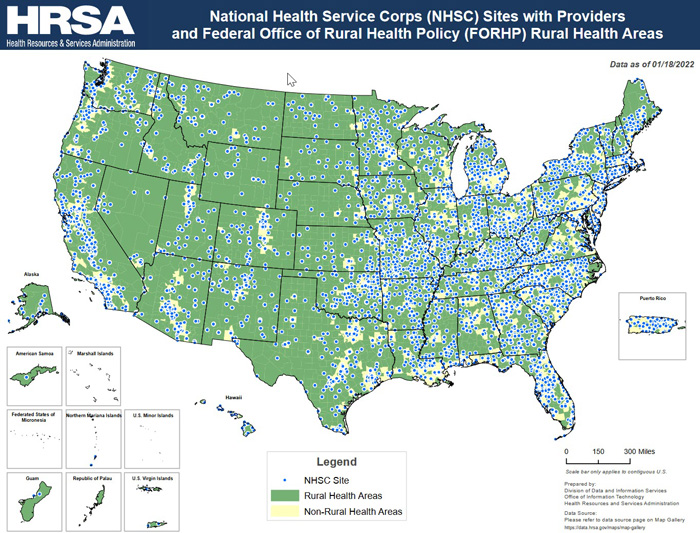
The NHSC offers primary care providers financial support in the form of loan repayment assistance and scholarships. More than 50,000 primary care medical, dental, mental, and behavioral health professionals have served in the National Health Service Corps since its inception. According to an April 2021 Government Accountability Office Report, in FY 2020, there were approximately 14,000 active participants in the NHSC, providing care at 7,000 sites in every state, the District of Columbia, and 5 territories. Approximately 44% of participating sites were classified as rural.
The following map from the HRSA Data Warehouse shows NHSC sites in rural areas. For the most recent data, click on the map to view the current version in the HRSA Data Warehouse.
The NHSC offers several financial aid programs, all of which seek applicants who have an interest in providing healthcare to rural and underserved populations:
- National Health Service Corps Scholarship Program – Offers scholarships to primary care health professions students who commit to serving in a rural or urban HPSA upon completion of a degree. Medical, dental, nurse practitioner, certified nurse midwife, and physician assistant students are eligible.
- Students to Service Loan Repayment Program – Through this program, students in their final year of medical school or dental school can receive financial assistance to pay back their student loans. Students must commit to providing primary care services in selected rural or urban HPSAs for three years.
- National Health Service Corps Loan Repayment Program – This program provides financial assistance to licensed providers in certain primary care professions who already serve or are applying for work in approved NHSC sites. Specific medical, dental, and mental/behavioral health providers are eligible. With the exception of Registered Dental Hygienists, all programs required graduate degrees.
NHSC Loan Repayment Programs include:
- State Loan Repayment Programs (SLRP) – These programs are funded in part by the Health Resources and Services Administration via the National Health Service Corps and also require participating states to match federal funds. Through these programs, states can receive federal grants that assist them in developing and maintaining loan repayment assistance for primary care providers who work in Health Professional Shortage Areas (HPSAs) in their state. States are required to match the funds provided by the federal government. Healthcare providers interested in participating should contact their state program to apply. HRSA provides a list of the state SLRP contacts for currently active SLRP grants.
- NHSC Rural Community Loan Repayment Program – Loan repayment assistance for medical, nursing, and behavioral/mental health clinicians with specific training and credentials to provide evidence-based substance use disorder treatment in rural communities designated as Health Professional Shortage Areas.
- NHSC Substance Use Disorder Workforce Loan Repayment Program – Administered by HRSA Bureau of Health Workforce, this program offers loan repayment assistance for substance use disorder clinicians who agree to serve in Health Professional Shortage Areas for at least 3 years.
What are some of the major loan repayment programs that can be used by rural healthcare professionals?
There are several loan repayment programs that could be useful to rural health professionals, many of which are offered by state or federal agencies. Besides the National Health Service Corps (see What is the National Health Service Corps and how does it affect rural healthcare?), other programs include:
- Nurse Corps Loan Repayment Program – This program is administered by HRSA and provides loan repayment assistance for nurses and nurse faculty to be used for repaying student loan obligations. Nurses who apply must commit to serving in a Critical Shortage Facility located in a primary care or mental health HPSA and nurse faculty must commit to work full-time at an accredited school of nursing.
- Indian Health Service Loan Repayment Program – This program provides loan repayment for a wide range of health professionals. Healthcare providers who are offered loan repayment through this program sign a two-year contractual agreement to serve full-time at an Indian Health Service Facility or approved Indian Health Program.
- Substance Use Disorder Treatment and Recovery Loan Repayment Program (STAR LRP) – Bureau of Health Workforce program that provides loan repayment assistance for substance use disorder (SUD) professionals providing direct treatment or recovery support services in an approved facility located in communities designated as a Mental Health Professional Shortage Area or in counties with an overdose death rate that is above the national average.
- Faculty Loan Repayment Program – The program offers loan repayment for individuals from disadvantaged backgrounds who agree to serve as faculty at eligible health professions schools for a minimum of 2 years.
Other federal and state agencies offer loan repayment programs. For a listing of other loan repayment programs, see RHIhub's Funding and Opportunities by Type: Loan Repayment Programs.
What are some of the major scholarship programs that can be used by rural healthcare professionals?
Scholarships and loan forgiveness programs can both be used by students who are currently working their way toward a health professions degree. Besides the National Health Service Corps (see What is the National Health Service Corps and how does it affect rural healthcare?), other scholarship/loan forgiveness programs include:
- Nurse CORPS Scholarship Program – This program is administered by HRSA and provides scholarships to students accepted or enrolled in a diploma, associate, baccalaureate, or graduate nursing program. Scholarship recipients must sign a two-year contractual agreement to serve in a Health Professional Shortage Area upon graduation.
-
Indian Health Service Scholarships – These scholarships are offered to American
Indian and
Alaska Native (AI/AN) students. For each year of scholarship awarded, recipients must agree to practice for
one year in a medically underserved area.
- Health Professions Scholarship: Available to AI/AN students of many health professions.
- Pre-Graduate Scholarship: Available to AI/AN students working toward a bachelor's degree in pre-medicine, pre-dentistry, or pre-podiatry.
- Preparatory Scholarship: Available to AI/AN students enrolled in undergraduate or preparatory courses for a degree in preclinical pharmacy, pre-nursing, pre-pharmacy, or pre-social work.
For a listing of other scholarship programs, see RHIhub's Funding and Opportunities by Type: Scholarships.
What do we know about the effectiveness of financial aid and loan repayment programs in attracting and retaining healthcare professionals in rural areas?
A 2016 report, National Health Service Corps – An Extended Analysis, found that 79% of NHSC participants were serving in HPSAs one year after the service obligation was completed. Six years after the completion of the service obligation, 30% were still practicing at the same HPSA, while 72% were practicing at any HPSA site.
Each year, the Bureau of Health Workforce is required to report to Congress on their programs. The NHSC reports on several measures including retention data. Reports for NHSC, NURSE Corps, and other Bureau of Health Workforce programs are available on the HRSA website.
What funding programs are available to colleges and universities to assist rural healthcare professions students with educational costs?
The growing need for healthcare professionals in rural areas has prompted a number of funding opportunities to support educational institutions that will train students for specific healthcare careers in rural areas. Many of these funding programs include dollars that can be used to support student tuition, living expenses, books, and educational materials.
The following funding programs include components that allow for financial assistance to defray the cost of educational expenses:
Indian Health Service Programs
HRSA Bureau of Health Workforce Programs
These programs are offered to colleges on different funding cycles. You can sign up for email updates from the Bureau of Health Workforce to get information about the release of funding opportunities.